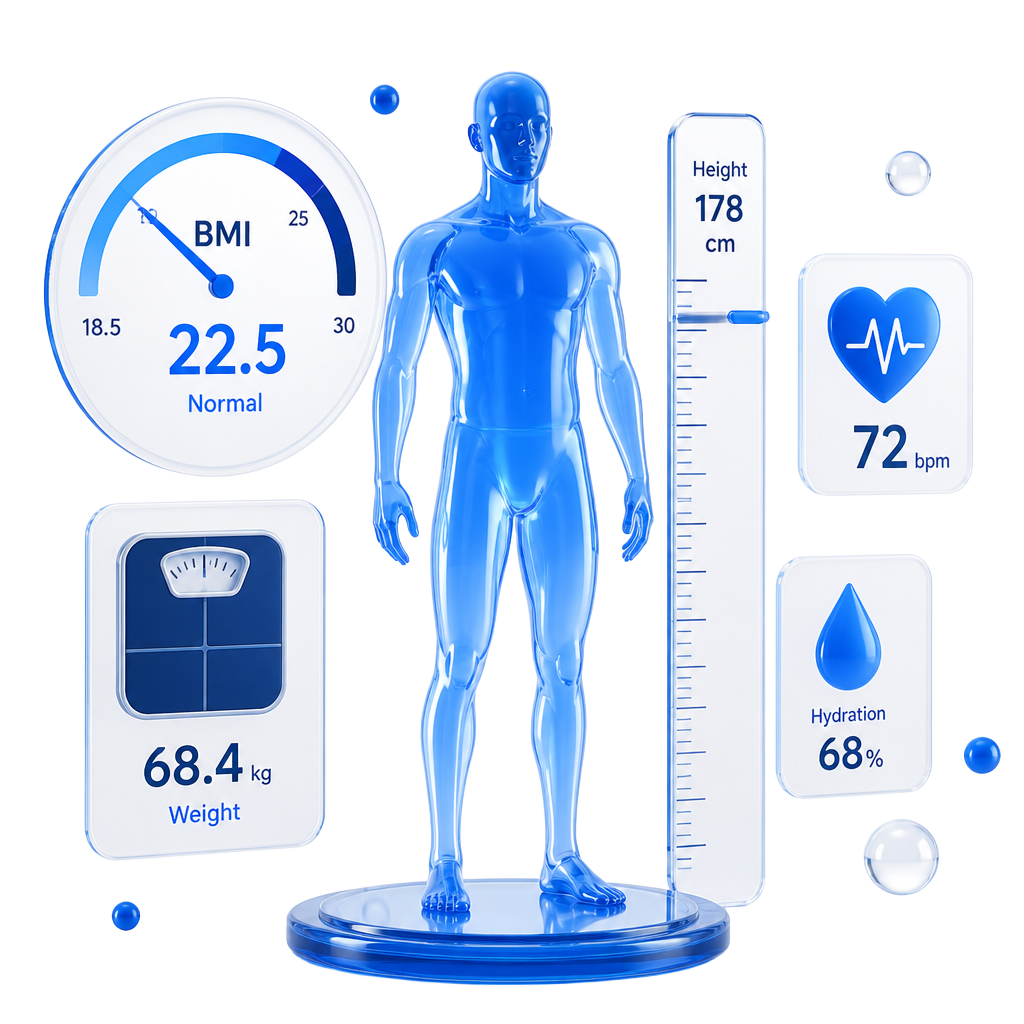
The complete guide to Body Mass Index
Body Mass Index is the most widely used screening measure in public health. It appears in clinical guidelines, insurance underwriting, national health surveys, gym assessments and research papers, and it is the number most people reach for when they want a quick answer to a simple question: is my weight in a healthy range for my height? This guide explains exactly what BMI is, where the formula came from, how the World Health Organization classification works, what BMI genuinely tells you, and — just as importantly — what it cannot tell you.
1. What BMI actually measures
BMI is a ratio, not a measurement of body fat. It compares body mass to the square of height, producing a single figure expressed in kilograms per square metre (kg/m²). The rationale is geometric: as people get taller, their mass tends to increase roughly in proportion to the square of their height rather than the cube, because human bodies do not scale uniformly in all three dimensions. Dividing weight by height squared therefore produces a number that is broadly comparable between a person of 1.60 m and a person of 1.90 m.
Because BMI needs only two inputs that anyone can measure at home with a scale and a tape, it became the default screening tool worldwide. A blood test, DEXA scan or hydrostatic weighing gives far richer information about body composition, but none of them can be applied to millions of people cheaply and consistently. BMI can.
2. Where the formula came from
The ratio was described in the 1830s by the Belgian mathematician and astronomer Adolphe Quetelet, who was studying the statistical distribution of human physical characteristics. For over a century it was known as the Quetelet Index. In 1972, the American physiologist Ancel Keys published a comparative study of obesity indices and concluded that the weight-to-height-squared ratio correlated best with measured body fatness among the simple options available; he renamed it the Body Mass Index. The WHO adopted BMI-based cut-off points for international comparison in the 1990s, and those cut-offs are still the global reference today.
3. The formula, in both unit systems
There are only two versions of the calculation, and they produce identical results for the same body.
Metric
BMI = weight (kg) ÷ height (m)²
A person of 78 kg and 1.80 m: 1.80 × 1.80 = 3.24, then 78 ÷ 3.24 = 24.1 kg/m², which sits inside the healthy range.
Imperial
BMI = weight (lb) × 703 ÷ height (in)²
A person of 172 lb and 71 in: 71 × 71 = 5041, then 172 × 703 ÷ 5041 = 24.0 kg/m². The factor 703 simply converts pounds per square inch into kilograms per square metre.
The most common mistake in manual calculation is squaring height in centimetres instead of metres, which produces a value ten thousand times too small. The second most common is forgetting the 703 conversion factor in imperial units. Our calculator converts every entry to kilograms and centimetres internally, so switching between metric and imperial never changes your result.
4. The WHO classification explained
The WHO defines adult categories using fixed cut-off points. They are the same for men and women, and they apply from roughly age 20 onwards.
| BMI (kg/m²) | Classification | Risk of comorbidities |
|---|---|---|
| Below 18.5 | Underweight | Increased (nutritional and bone health) |
| 18.5 – 24.9 | Normal weight | Average |
| 25.0 – 29.9 | Overweight (pre-obesity) | Mildly increased |
| 30.0 – 34.9 | Obesity Class I | Moderate |
| 35.0 – 39.9 | Obesity Class II | Severe |
| 40.0 and above | Obesity Class III | Very severe |
The boundaries are not arbitrary. They were chosen because large cohort studies show that mortality and metabolic disease risk curves begin to rise measurably around these points. The relationship is J-shaped: risk is elevated at very low BMI values, reaches its minimum somewhere in the low-to-mid twenties, and rises progressively above 25.
The WHO also publishes alternative Asian cut-off points, because populations of South and East Asian descent tend to develop type 2 diabetes and cardiovascular disease at lower BMI values. In several Asian national guidelines, overweight begins at 23.0 and obesity at 27.5. If this applies to you, interpret the standard categories conservatively.
5. Turning BMI back into a weight range
A BMI number on its own is abstract. It becomes actionable when you convert the healthy band back into kilograms for your own height, which is what the calculator above does automatically. Multiply 18.5 and 24.9 by your height in metres squared and you get your personal healthy weight window.
For a height of 1.70 m: 1.70² = 2.89, so the healthy window is 18.5 × 2.89 = 53.5 kg to 24.9 × 2.89 = 72.0 kg. That is an 18.5 kg span — a reminder that “healthy weight” is a range, not a target, and that two equally healthy people of the same height can differ substantially in mass depending on frame size and muscularity.
Ideal weight versus healthy range
Ideal body weight formulas such as Devine (1974), Robinson (1983) and Hamwi (1964) predate modern body-composition science and return a single figure rather than a range. They are still used for drug dosing and ventilator settings. Treat the ideal-weight number in your results as a reference point, and the BMI-derived range as the more meaningful goal.
6. The metrics that sit alongside BMI
Clinicians rarely look at BMI alone. Four companions add most of the missing information.
Waist circumference
Measured at the midpoint between the lowest rib and the top of the hip bone, waist circumference captures visceral fat — the metabolically active fat around the organs that drives insulin resistance. Risk rises above roughly 94 cm in men and 80 cm in women, with substantially higher risk above 102 cm and 88 cm respectively.
Waist-to-height ratio
Dividing waist by height gives a simple, height-adjusted indicator of central adiposity. A widely used rule of thumb is to keep your waist below half your height.
Body fat percentage
The Deurenberg equation used in your results estimates body fat from BMI, age and sex. It is useful at population level, with a typical error of around 4 percentage points for an individual — good enough to spot a trend, not precise enough to set a target.
Basal metabolic rate
The Mifflin–St Jeor equation estimates the energy your body uses at complete rest. Multiplying it by an activity factor gives your maintenance calories, the anchor point for any deliberate weight change.
7. Advantages of BMI
BMI is free, instant, reproducible and universally understood. It requires no equipment beyond a scale and a tape measure, produces the same answer in any clinic in the world, and has decades of epidemiological data attached to it — meaning that a BMI of 31 has a known statistical association with hypertension, sleep apnoea, type 2 diabetes and several cancers. Very few health metrics combine that evidence base with that little friction.
It is also an effective triage tool. A BMI outside the healthy range is a signal to look closer: to check blood pressure, fasting glucose and lipids, to ask about diet and activity, and to consider whether weight is changing over time. That is exactly what a screening measure is supposed to do.
8. Limitations you should know about
BMI cannot distinguish muscle from fat. A rugby player, a powerlifter and a sprinter may all register a BMI above 27 while carrying under 12% body fat. Conversely, a sedentary person with low muscle mass can sit at a BMI of 23 while carrying an unhealthy proportion of fat — a pattern sometimes described as normal-weight obesity.
BMI also ignores fat distribution. Two people with identical BMI values carry different risk if one stores fat subcutaneously on the hips and the other stores it viscerally around the abdomen. It does not account for bone density, hydration status, pregnancy, limb amputation, or the natural loss of muscle and height that occurs with ageing.
For children and adolescents aged 2 to 19, fixed cut-offs are invalid; growth-referenced BMI-for-age percentiles are used instead. For adults over about 65, several studies suggest a slightly higher BMI is protective, so the standard overweight threshold is often interpreted loosely. Pregnancy makes BMI meaningless as a body-composition indicator, and pre-pregnancy BMI is used instead for gestational weight-gain guidance.
9. Changing your BMI safely
Because BMI is driven by weight, changing it means changing energy balance — but the method matters more than the arithmetic. A moderate deficit of 300 to 500 kcal per day produces roughly 0.25 to 0.5 kg of loss per week and preserves lean mass. Aggressive deficits accelerate the scale but sacrifice muscle, lower resting metabolic rate and are strongly associated with rebound.
Three factors do most of the work: protein intake of about 1.2–1.6 g per kilogram of body weight to protect muscle and increase satiety; resistance training two or three times a week to maintain lean mass; and sleep of seven to nine hours, since short sleep reliably increases appetite hormones and reduces adherence. If you need to gain weight, the same principles apply in reverse — a modest surplus with adequate protein and strength training adds tissue you actually want.
Recalculate your BMI monthly rather than daily. Body weight fluctuates by one to two kilograms across a normal week from hydration, sodium, glycogen and digestive contents; only the multi-week trend reflects real change.
10. When to involve a professional
Speak to a healthcare professional if your BMI is below 18.5 or at or above 30, if your weight has changed by more than about 5% without you intending it, if you have a family history of cardiometabolic disease, if you are pregnant or planning pregnancy, or if you are considering medication or surgery for weight management. A clinician can order the tests BMI cannot substitute for and interpret the result in the context of your full medical history.
11. Using your result well
Treat BMI as the first sentence of a conversation about your health, not the conclusion. It is a fast, well-validated, universally comparable screening number that flags whether a closer look is warranted. Combine it with your waist measurement, your activity habits, your blood pressure and your bloodwork, and you have a genuinely useful picture. Use the calculator at the top of this page whenever you want to check where you stand, save the result to your history, and watch the trend rather than the single number.
Ready to check your number?
Scroll back to the BMI calculator, or explore the related health calculators for body fat, ideal weight, hydration and daily calories. Questions? The FAQ section covers the most common ones.